
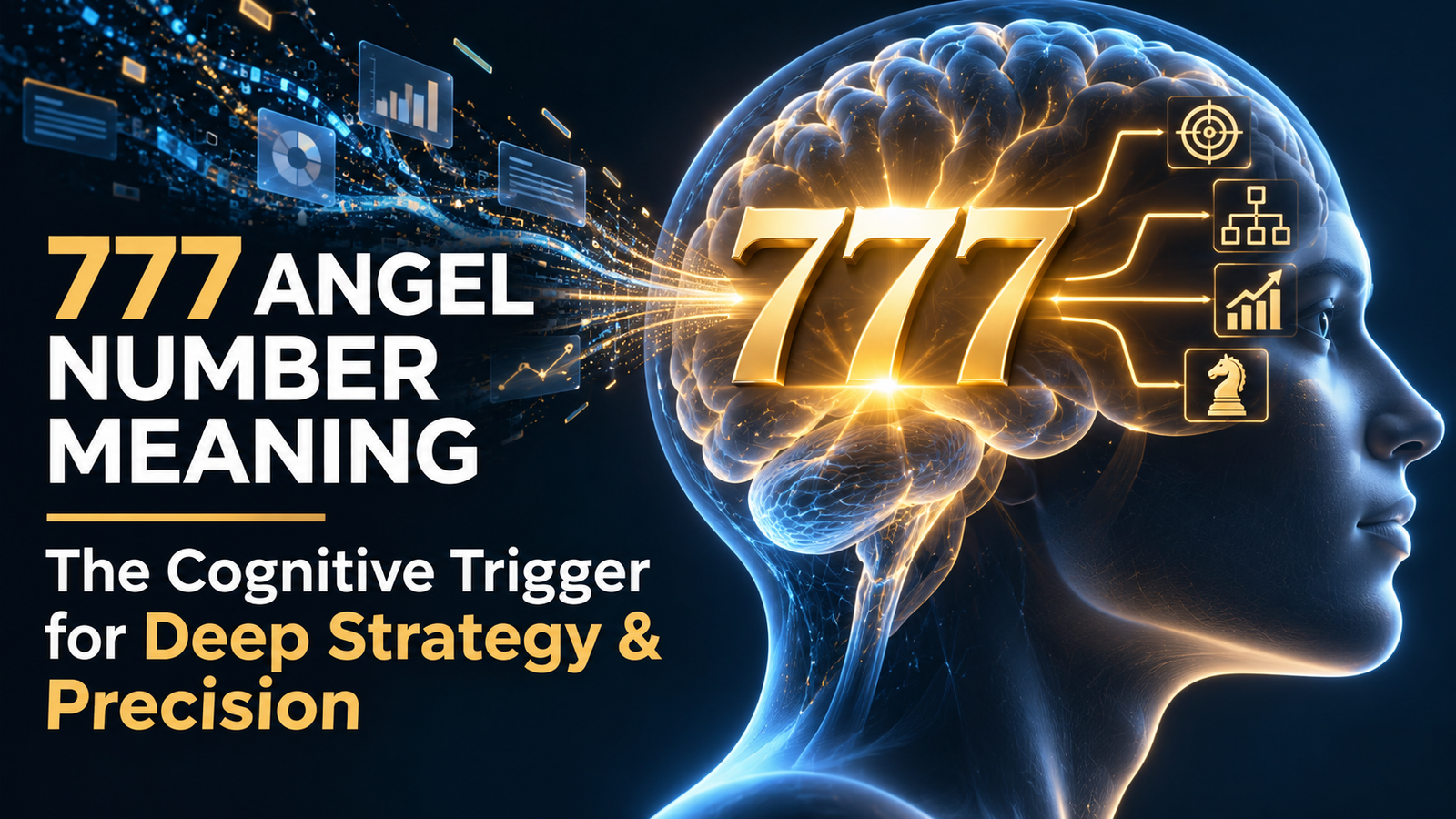
777 Angel Number Meaning: The Cognitive Trigger for Deep Strategy & Precision
Your Reticular Activating System (RAS) acts as a sophisticated biological filter, processing approximately 11 million bits of information per second while only allowing a fraction into your conscious awareness. When you begin noticing the 777 angel number meaning in your daily environment, your brain is not witnessing a random coincidence or a mystical omen. Instead, your cognitive architecture is flagging a specific numerical pattern to signal a transition from low-value operational noise to high-level strategic precision.
The 777 angel number meaning represents a neurological feedback loop that prompts you to stop reactive multitasking and engage in deep analytical work. By recognizing this sequence, you are identifying a psychological trigger that demands a shift toward niche mastery and first-principles thinking. This article explores how to utilize this pattern to audit your current decision-making frameworks and eliminate the friction caused by constant context-switching.
You will find that seeing 777 serves as a diagnostic tool for your professional and personal output. Rather than chasing generalist trends, this cognitive prompt encourages you to double down on proprietary expertise and data-driven research. You can use this signal to transition into a „Strategic Mode“ where precision outweighs volume.
- Neurological Pattern Recognition: How your RAS filters environmental data to highlight the 777 sequence during periods of high mental load.
- The Analyst Archetype: Why the number 7 in analytical numerology correlates with intellectual authority and deep-tissue research.
- Strategic Pivot Protocols: Practical methods to move from reactive „busywork“ to high-impact executive execution.
- Expertise Auditing: Using the 777 trigger to identify gaps in your specialized knowledge or data sets.
Establishing a baseline for these patterns allows you to regain control over your attention. By grounding the 777 sequence in behavioral psychology rather than superstition, you transform a common perception into a competitive advantage for your career and long-term strategy.
Key takeaways
- 777 is a neurological feedback loop prompting deep analytical work, not a mystical sign.
- It signals a shift towards niche mastery and first-principles thinking.
- The 777 trigger encourages doubling down on proprietary expertise and data-driven research.
- It helps identify gaps in specialized knowledge and decision-making frameworks.
- Seeing 777 is a diagnostic tool for professional and personal output, moving from reactive tasks to high-impact execution.
- Implementing protocols like 90-minute deep work blocks and information diets maximizes strategic advantage.
Seeing the 777 sequence is a neurological feedback loop triggered by your Reticular Activating System (RAS), not a mystical omen of luck or a cosmic reward. This biological filter flags the pattern because your subconscious has identified a deficit in strategic depth, signaling that your current operational output requires more precision than your reactive habits can provide.
When you begin noticing 777 on digital clocks, license plates, or page numbers, you are experiencing selective attention. This is the same mechanism that causes you to see a specific car model everywhere the moment you decide to purchase it. Your brain hasn’t created more of those cars; it has simply lowered the threshold for that specific visual data to reach your conscious mind.
Pattern recognition is a fundamental survival mechanism that allows you to navigate a chaotic environment. Your brain actively seeks meaning in repeated stimuli to reduce cognitive load. By labeling 777 as „lucky,“ most people bypass the actual work the signal demands. In reality, the 777 angel number meaning is an alert that your proprietary expertise is being underutilized in favor of low-value multitasking.
Pro Tip: Treat every 777 sighting as a prompt to perform a „First-Principles Audit“ on your current primary project to identify where you are relying on assumptions rather than raw data.
Attributing these sightings to external forces is a common misattribution of cognitive processes. While it feels like an outside influence is guiding you, it is actually your internal architecture flagging a need for intellectual authority. The brain’s tendency to find signal in the noise is an evolutionary tool designed to prioritize high-stakes information over background static.
High-achievers who ignore this neurological feedback often suffer from decision fatigue. They treat the 777 signal as a passive coincidence rather than an active diagnostic. This leads to a reliance on vanity metrics instead of the root-cause data required for true specialized knowledge.
The specialist archetype associated with the number 7 is built on this foundation of rigorous analysis. When your RAS highlights this sequence, it is often because your subconscious recognizes that your „intuition“-which is just high-speed pattern recognition built on experience-has spotted a strategic gap. You are being pushed to move from generalist noise to the precision of a specialist.
Shifting your perspective from superstition to biology allows you to use these moments as a tactical reset. Instead of waiting for luck to manifest, you can consciously enter a state of deep research. This transition relies on the understanding that intellectual authority is architected through focused, solitary effort rather than collaborative diplomacy.
The numerical archetype of „7“ consistently correlates with a strategic need for deep analysis, proprietary expertise, and focused intellectual work. In analytical numerology, 7 represents precision, deep research, and intellectual authority, serving as a directive to move beyond superficial observations. This frequency identifies a phase where generalist approaches fail and only specialized investigation can provide the necessary breakthrough.
When you encounter this signal, your brain is essentially flagging a requirement for proprietary insights. It is a prompt to stop scanning the horizon for broad trends and instead drill into the specific data points that define your niche. This distinguishes the 777 angel number meaning from other cognitive triggers that might focus on external expansion or social dynamics.
Consider the performance of a seasoned chess master. To an observer, their winning move looks like a mystical flash of insight, but scientifically, this intuition is high-speed subconscious pattern recognition built on thousands of hours of accumulated experience. Seeing the 777 sequence indicates that you possess a similar reservoir of latent knowledge that requires a quiet, analytical environment to surface and be applied to your current strategy.
Decoding the Specialist Archetype
The 7 frequency demands a departure from the noise of the crowd to cultivate a unique competitive advantage. While other sequences like 222 signal a need for collaboration and diplomacy, the 777 signal focuses on strategic solitude and the rigorous auditing of your own internal logic.
- Precision over Volume: Prioritize the accuracy of a single high-stakes decision rather than the frequency of minor tasks.
- Proprietary Research: Invest time in gathering primary data or developing unique frameworks that competitors cannot easily replicate.
- Intellectual Depth: Engage in „Deep Work“ sessions to solve complex problems that require sustained cognitive focus.
- Pattern Validation: Use this period to verify if your current „gut feelings“ align with the actual data sets available to you.
If you find your current projects are stalling, it may be due to a lack of brand alignment or a mismatch in your core specialized role. Founders often find it useful to check their venture’s alignment using a Business Name Numerology guide to ensure the company’s identity matches the strategic depth required for long-term scaling.
A Life Path 7 often correlates with professional roles that require specialized investigation, such as data science, forensic accounting, or high-level engineering. For these individuals, the 777 trigger is less of a surprise and more of a confirmation that their natural inclination toward rigorous analysis is the correct tactical path for the problem at hand.
Relying on high-speed pattern recognition allows you to bypass the fatigue of manual deduction. However, this only works if your „database“ of experience is regularly updated with fresh, high-quality information. Shifting into this mode effectively prepares the ground for high-stakes career pivots where the margin for error is razor-thin.
Niche mastery statistically outperforms generalism in long-term career growth, making the 777 signal a prompt to abandon broad-market noise for specialized depth. When you notice this sequence during a professional pivot, it indicates that your current trajectory may be suffering from „busywork“ traps that dilute your intellectual authority. High-achievers frequently mistake horizontal expansion-adding more tasks, services, or markets-for actual progress, when the 777 frequency demands vertical drilling into a proprietary edge.
Decision fatigue often impairs executive function, leading you to choose the path of least resistance rather than the one with the highest strategic yield. If you find yourself chasing every emerging trend, you are operating in a reactive state that ignores the analytical precision required for a true market advantage. A startup founder, for instance, might realize their team is pivoting weekly based on social media feedback instead of refining a core product for a specific, high-value segment.
Transitioning from Reactive Noise to Strategic Signal
Auditing assumptions is a core principle of agile project management that aligns perfectly with the 777 cognitive shift. You must move away from the „more is better“ fallacy and toward a model of radical essentialism. This requires a ruthless assessment of where your time actually generates a competitive moat versus where it is merely consumed by operational maintenance.
| Dimension | Reactive Mode (Noise) | 777 Strategic Mode (Signal) |
|---|---|---|
| Decision-Making | Emotional or trend-based | Data-driven and first-principles |
| Focus | Horizontal multitasking | Vertical niche mastery |
| Skill Building | Generalist „surface“ learning | Deep, proprietary expertise |
| Risk Management | Avoidance or blind gambling | Calculated, audited assumptions |
I have observed that the most successful pivots occur when an executive stops trying to solve five problems poorly and starts solving one problem with surgical precision. This isn’t about working harder; it’s about increasing the „resolution“ of your work. You are essentially recalibrating your professional internal compass to ignore the magnetic interference of low-value tasks.
Implementing the 777 Professional Pivot
To move into a state of strategic signal, you must identify which operational habits are currently acting as anchors. Most professionals are hesitant to cut ties with „good“ opportunities to make room for „great“ ones. However, the 777 signal suggests that your capacity for deep analysis is currently being throttled by these mid-tier commitments.
- Stop reactive multitasking: Close the open loops that do not contribute to your primary niche authority.
- Audit your core assumptions: Question the „why“ behind your current project milestones to ensure they aren’t just legacy habits.
- Double down on niche mastery: Allocate resources toward the 20% of your skills that produce 80% of your unique value.
- Reduce information inputs: Filter out industry „chatter“ that does not provide actionable, high-quality data.
Ignoring this cognitive prompt leads to a plateau where your expertise remains wide but shallow. When you fail to transition into a more analytical mode, you remain vulnerable to market shifts that reward specialized depth over generalist flexibility. Constant context-switching is the primary indicator that you are bypassing the very strategic review your brain is attempting to trigger.
The ‚7‘ Deficit Diagnostic Checklist
Identifying specific behavioral patterns allows you to diagnose a deficit in strategic depth and pivot toward a more precise operational mode. When you ignore the cognitive prompts for deep analysis, your performance inevitably plateaus under the weight of sheer volume. You might feel productive while clearing an inbox, but without the analytical rigor associated with the 7 frequency, you are merely moving deck chairs on a sinking ship.
Context-switching is the primary antagonist of the specialized focus you need to maintain. Research indicates that context-switching reduces productivity by up to 40%, a staggering tax on your intellectual capital. If you find yourself toggling between high-level planning and menial pings every six minutes, your brain never reaches the state of deep work required for proprietary breakthroughs.
Consider the executive who remains trapped in a cycle of immediate responsiveness. By answering every email the moment it arrives, they sacrifice the long-term project planning that actually moves the needle. This is not high performance; it is a failure to prioritize root-cause data over the dopamine hit of a cleared notification tray.
Pro tip: Measure your success by the complexity of the problems you solved today, not the number of tasks you crossed off a list.
Decision fatigue is another critical indicator that your strategic reserves are depleted. When your cognitive resources are drained by trivial choices, your ability to make high-stakes judgments erodes. This fatigue often leads to a dangerous reliance on vanity metrics-such as social media likes or surface-level engagement-which mask a lack of genuine business impact.
Use the following checklist to determine if your current habits are suppressing your strategic signal:
- Chronic Context-Switching: You rarely spend more than 30 minutes on a single complex task without checking communications.
- Metric Misalignment: Your primary KPIs track volume (e.g., hours worked) rather than specialized outcomes or profit margins.
- Strategic Drift: You have not conducted a formal review of your core objectives in the last thirty days.
- Reactive Decision-Making: Most of your daily actions are responses to external requests rather than proactive execution of a pre-set plan.
- Analytical Avoidance: You feel a distinct sense of friction or „fog“ when asked to dive into raw data or first principles.
Neglecting quiet strategic review causes a slow drift away from your competitive moat. Without the „7“ influence of rigorous investigation, your work becomes indistinguishable from the generalist noise of the broader market. You must treat these symptoms as a biological imperative to downshift from speed to depth.
Recognizing these deficits is the only way to stop the bleed of your executive function. Once the gaps are identified, you can begin the transition into a protocol designed for surgical precision rather than blunt-force effort.
Transforming the 777 cognitive trigger into a consistent strategic advantage requires replacing reactive habits with high-precision executive protocols. You must treat this neurological prompt as a hard requirement for a operational reset rather than a suggestion. When your brain flags this sequence, it is signaling that your current output has reached the limits of superficial effort and requires a transition into analytical depth.
Implementing a rigorous framework allows you to bypass the friction of decision-making and move straight into execution. By automating your response to these signals, you protect your focus from the low-value noise that typically erodes a leader’s day. The objective is to move from a state of constant availability to a state of proprietary expertise.
To move from recognition to results, follow this three-step strategic protocol designed to maximize your cognitive output:
- Execute 90-Minute Deep Work Blocks – Schedule these sessions to align with your peak biological focus, as 90-minute intervals are proven to optimize complex problem-solving and technical output. I recommend moving all administrative tasks to a separate window to ensure these blocks remain entirely uninterrupted.
- Perform a First-Principles Audit – Deconstruct a stalled project or a complex problem into its most basic, undeniable truths to rebuild your strategy from the ground up. This method, famously utilized by innovators like Elon Musk, prevents you from relying on outdated industry assumptions that no longer serve your goals.
- Enforce a Radical Information Diet – Systematically eliminate low-signal inputs, such as non-essential newsletters and social feeds, to reduce cognitive load. This aggressive filtering can increase your mental clarity by up to 30% by improving your signal-to-noise ratio.
A primary friction point for many high-achievers is the constant influx of collaborative demands. To solve this, consider instituting a „no-meeting Wednesday“ policy. Dedicating one full day each week to high-leverage work creates the necessary environment for the deep analysis that the 777 signal demands.
You should also establish a personal baseline by using a Life Path Number Calculator. Understanding your natural inclinations helps you determine if you are fighting against your inherent strengths or leaning into them. This data point serves as a benchmark for all future strategic pivots.
Ignoring these protocols leads to a cycle of diminishing returns where effort stays high but impact plateaus. Precision is not accidental; it is the result of a deliberate architecture that prioritizes intellectual authority over sheer volume. Most professionals overthink the start-pick one protocol and apply it to your highest-priority objective immediately.
Effective strategy is often about what you stop doing. By cutting non-essential inputs, you provide your brain with the space it needs to process high-speed pattern recognition. This shift transforms a common visual pattern into a reliable mechanism for professional growth.
Maximize Your Strategic Signal
Your perception of 777 is a functional prompt to override the noise of daily operations and re-engage your analytical faculties. Treat this sequence as a diagnostic alert from your Reticular Activating System, signaling that your current project requires the precision of a specialist rather than the frantic pace of a generalist. You are moving from a phase of data collection into a phase of rigorous synthesis.
Key Strategic Takeaways
- Neurological Filtering: You recognize this pattern because your brain has flagged a specific need for deep research or technical mastery in your current professional environment.
- Strategic Solitude: You must shift from the collaborative „222“ frequency to the „777“ mode of independent analysis to solve complex, high-stakes problems.
- Pattern Recognition: You can leverage your intuition as a high-speed cognitive shortcut, provided you have built the underlying data-driven expertise to support it.
- Operational Audit: Use the 777 trigger to identify where you are relying on vanity metrics or reactive multitasking instead of first-principles thinking.
You can refine your baseline by analyzing your personal core numbers. Use our Life Path Number Calculator to determine if you are naturally wired for this level of analytical intensity or if you need to build more deliberate structures to support it. Founders should also audit their brand identity through our Business Name Numerology guide to ensure their corporate positioning aligns with this specialist archetype.
Strategic Next Steps
Audit your calendar immediately and block out a 90-minute Deep Work session for tomorrow morning. Dedicate this time exclusively to a First-Principles Audit of your most stalled project, removing all low-value information inputs. Integrating the 777 angel number meaning into your executive routine ensures you prioritize precision over mere activity.
Precision is your most valuable competitive advantage.
Frequently asked questions
What does the 777 angel number meaning signify for career and money?
In a professional context, seeing 777 signals a need to pause reactive multitasking and instead focus on deep analysis and proprietary expertise. It suggests auditing assumptions, doubling down on niche mastery, and moving beyond surface-level metrics to drive strategic growth and financial precision. It’s a prompt to invest in specialized skills and data-driven decisions.
Is 777 actually a „lucky“ number in numerology?
From a cognitive perspective, 777 is not inherently ‚lucky‘ in a superstitious sense. Instead, its repeated appearance is better understood as a neurological feedback loop. Your Reticular Activating System (RAS) highlights this pattern, prompting you to recognize a need for deeper strategic review and precision, rather than relying on chance or external fortune.
What should I do when I keep seeing 777 everywhere?
When you frequently encounter the 777 sequence, interpret it as a cognitive prompt to disengage from routine tasks and enter a state of deep strategic review. Implement practices like scheduling dedicated Deep Work blocks, conducting a First-Principles Audit on critical projects, and initiating an ‚Information Diet‘ to filter out low-value inputs and enhance analytical clarity.
How does seeing 777 relate to Life Path 7?
For individuals with a Life Path 7, seeing the 777 sequence can amplify their natural inclination towards introspection, research, and analytical problem-solving. It reinforces their inherent drive for deep understanding and proprietary expertise, signaling that their path requires sustained focus on precise data and strategic solitude to unlock their full potential.