Master Numbers Explained: The Architecture of High-Frequency Leadership
Your psychological makeup functions at a higher frequency than 89% of the population, creating a high-stakes environment where your leadership potential is as massive as your risk of total exhaustion. If your personal data reveals an 11, 22, or 33, you are operating on a Master Number baseline. In my years as a corporate strategist, I have seen brilliant executives flame out because they treated these high-output patterns like standard single-digit traits. They didn’t realize they were driving a Formula 1 engine in a school zone.
You can think of these numbers as intensifiers. An 11 is a high-speed version of the 2; a 22 doubles the structural power of a 4; and a 33 amplifies the supportive nature of a 6. This creates a complex cognitive architecture designed for macro-level impact, but it requires a specific set of rules to manage. Without a clear strategy, your high-frequency baseline will lead to chronic anxiety rather than professional mastery.
Pro tip: Mastering your internal frequency is the only way to prevent your natural drive from turning into executive burnout.
By understanding your specific profile, you will learn to navigate the tension between your high-speed pattern recognition and the practical demands of your career. You will gain a clear, data-driven framework for managing your energy, setting radical boundaries, and aligning your unique psychological architecture with your long-term professional goals. This is about moving from accidental intensity to strategic leadership.
Your High-Frequency Baseline: What Master Numbers Mean for You
Think of a Master Number as a specialized cognitive architecture designed for heavy lifting, rather than a badge of spiritual superiority. In professional terms, possessing an 11, 22, or 33 means your baseline psychological frequency is more concentrated than the standard single-digit profiles. This intensity isn’t a gift you receive; it is a neutral operational demand that dictates how you process information and lead teams.
The Mechanics of Intensification
A Master Number functions as a compounded version of its root digit. While a standard profile might focus on localized tasks, these intensified frequencies push your focus toward macro-level impact and systemic change. I have observed executives fail not because they lacked talent, but because they tried to run a high-frequency internal system on a low-stakes, „business as usual“ schedule.
The relationship between these numbers and their single-digit counterparts is strictly structural:
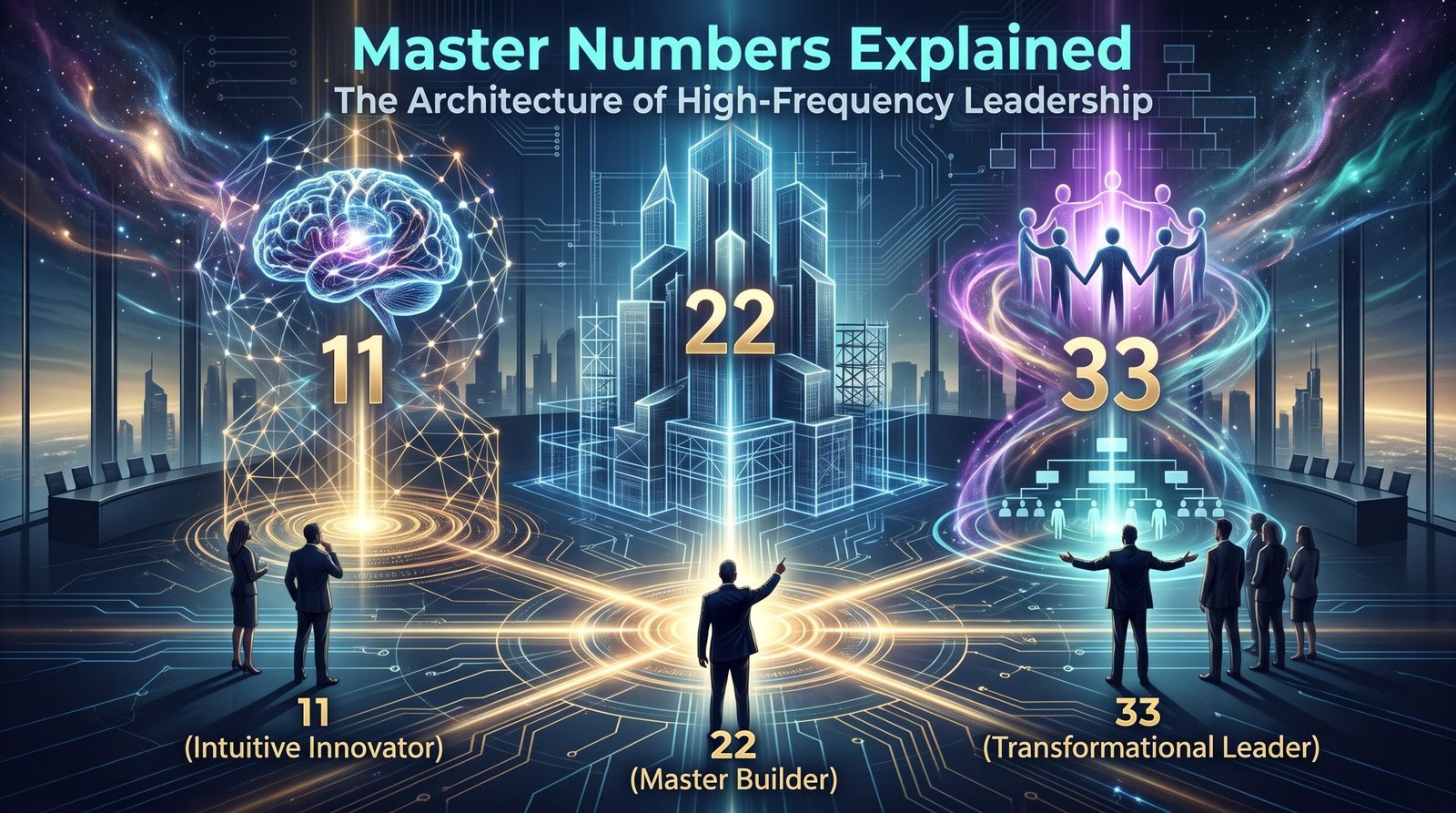
- Master Number 11 serves as an intensified 2, shifting from simple cooperation to advanced pattern recognition and strategic intuition.
- Master Number 22 functions as an intensified 4, moving from basic project management to large-scale systems architecture.
- Master Number 33 acts as an intensified 6, evolving from individual coaching to organizational transformation and structural empathy.
The Price of Cognitive Load
Operating at this level creates a unique psychological weight. Because your internal processor is running faster, the friction between your vision and reality can lead to executive burnout if not managed with military-grade discipline. It is a common mistake in high-performance coaching to treat this exhaustion as standard stress; in reality, it is often a „system overheat“ caused by misaligned energy.
You must recognize that your blueprint is built for influence that scales. If you ignore this and play small, the unused frequency turns inward, manifesting as chronic anxiety or imposter syndrome. Understanding that your calculation is unique-and why these numbers are never reduced during your assessment-is the first step in stabilizing your leadership output.
Your profile is determined by a specific arithmetic sequence that identifies whether you carry a standard or master frequency. Most people assume all double-digit numbers must be simplified to a single digit, but in high-performance numerology, that logic fails. Reducing a 22 to a 4 is like trying to run enterprise-grade software on a handheld calculator; you lose the structural integrity required for macro-level impact.
How to Identify Your Cognitive Architecture
Calculating your Life Path number requires a methodical breakdown of your birth date. To ensure you don’t misidentify your core profile, follow this strict reduction process:
- Isolate the components – Write out your full birth date (Month, Day, Year) and reduce each unit to a single digit. For example, a year like 1985 becomes 1+9+8+5=23, then 2+3=5.
- Identify the Master exception – If any individual unit (Month, Day, or Year) totals 11, 22, or 33, stop immediately. Do not reduce these units further at this stage.
- Aggregate the totals – Add the three resulting numbers together. If your final sum is 11, 22, or 33, you have hit a Master Number baseline.
Pro Tip: If you find yourself constantly over-analyzing simple tasks or feeling a „phantom“ pressure to build something massive, double-check your math; you likely missed a non-reduction point.
The Behavioral Logic of Non-Reduction
The reason we stop at 11, 22, or 33 is grounded in psychological tension. These numbers represent a distinct behavioral architecture that creates a specific internal friction. If you simplify them, you ignore the inherent complexity and the high cognitive load that defines your leadership style.
I have seen executives struggle with imposter syndrome simply because they were trying to live as a „4“ when their blueprint was a 22. They were optimizing for stability when they were built for systemic expansion. You can verify your own baseline right now to see if these high-frequency rules apply to your career trajectory.
[INSERT CALCULATOR LINK]
Failing to recognize these non-reduced numbers often leads to a mismatch between your output and your internal capacity. This structural integrity is what separates standard management from the intense psychological challenges you will face as a high-frequency leader.
Operating with a Master Number profile creates a psychological „tax“ that demands a more rigorous energy management system than standard leadership roles. While your cognitive architecture allows for macro-level pattern recognition, it also exposes you to a higher risk of chronic anxiety. This tension occurs because your internal expectations often outpace the physical reality of the organizations you lead.
The Architecture of Chronic Anxiety and Imposter Syndrome
In my experience coaching high-output executives, I’ve noticed that those with these specific profiles suffer from imposter syndrome despite having a track record of objective success. You likely feel like you are failing because you measure yourself against the massive potential of your profile rather than your actual accomplishments. This gap between your internal „high-frequency“ vision and the slower pace of your team creates a constant state of psychological stress.
Chronic anxiety in this context is not a flaw; it is a sign that your energy is being turned inward rather than being directed toward a structural goal. When you operate out of alignment with your specific archetype, the friction manifests as mental fatigue. I have seen brilliant strategists hit a wall because they tried to ignore this internal load, treating themselves like standard hardware when they are actually specialized high-performance machinery.
Mitigating Executive Burnout Through Radical Boundaries
To maintain mental equilibrium, you must implement radical boundary setting as a non-negotiable part of your operating procedure. This is not about work-life balance; it is about protecting your cognitive bandwidth from low-level distractions that drain your capacity for macro-level impact. Without these guardrails, executive burnout is not just a possibility-it is an architectural certainty.
- Audit your daily tasks to identify „low-frequency“ drains that do not align with your leadership archetype.
- Schedule specific recovery blocks to reset your nervous system after high-stakes decision-making.
- Externalize your vision through documentation to reduce the mental load of holding complex patterns in your head.
- Practice structural empathy toward yourself by acknowledging the increased energy requirements of your profile.
Managing this burden requires you to view self-regulation as a strategic asset rather than a luxury. If you fail to respect the limits of your psychological architecture, you risk a total system collapse that can take months to repair. Strategic alignment is the only sustainable way to leverage your potential without sacrificing your mental health.
Exploring Your Leadership Archetype: The Three High-Frequency Profiles
While the psychological tax of a Master Number is a shared reality, the way that energy manifests in your professional life depends entirely on your specific archetype. You aren’t just managing a generic „high-frequency“ load; you are wired for a particular brand of impact that dictates how you process information and lead teams.
The Intuitive Innovator: Master Number 11
If you carry the 11 profile, your primary asset is high-speed pattern recognition. You likely find yourself reaching conclusions or spotting market shifts long before your peers have even finished reviewing the data. This isn’t a „gut feeling“ in the mystical sense-it is a cognitive architecture designed for strategic intuition and rapid-fire synthesis of complex variables.
The challenge for you is the gap between your instant insight and the slower pace of organizational consensus. You see the future clearly, but you must learn to translate that vision into a language your team can follow without burning out from the friction. To fully understand how to leverage this frequency, explore our complete deep-dive into Master Number 11.
The Master Builder: Master Number 22
Those with a 22 profile operate as the architects of scale. While others focus on the „what,“ you are naturally obsessed with the „how“-specifically, how to build systems that survive beyond your personal involvement. Your cognitive baseline is tuned for empire-building, allowing you to maintain a macro-level view of a global operation while simultaneously tracking the structural integrity of its foundation.
You likely struggle with the sheer weight of your own ambitions, as your internal blueprint for success is often larger than what current resources allow. Your work is about turning abstract ideas into tangible, lasting infrastructure that can support thousands. To fully understand how to leverage this frequency, explore our complete deep-dive into Master Number 22.
The Transformational Leader: Master Number 33
The 33 profile represents a shift toward structural empathy and the psychology of the collective. You aren’t just interested in the product or the system; you are focused on the human element that powers it all. Your leadership style centers on organizational psychology, aiming to uplift the standard of an entire industry or community through high-integrity influence.
This profile often feels a massive responsibility to serve as a moral or professional compass, which can lead to significant self-sacrifice if not managed. You lead by modeling a higher standard of behavior that forces everyone around you to level up. To fully understand how to leverage this frequency, explore our complete deep-dive into Master Number 33.
Your Strategic Mandate for High-Frequency Leadership
Your Master Number is a blueprint for high-output leadership that functions like a high-performance engine; it produces massive power but requires a specialized cooling system to prevent total mechanical failure. You must treat your cognitive architecture as a professional responsibility rather than a personal trait. If you ignore the structural demands of your frequency, you risk the same executive burnout that collapses many high-potential careers.
Key Takeaways for Managing Your Potential
- Frequency is not a gift: You possess a concentrated psychological baseline that requires more maintenance than standard single-digit profiles.
- Burnout is structural: High-frequency anxiety often stems from a mismatch between your internal capacity for macro-level impact and your current daily tasks.
- Precision matters: You cannot reduce an 11, 22, or 33 because the tension between the master frequency and its base number (2, 4, or 6) is where your strategic edge lives.
- Alignment is mandatory: Without a clear, large-scale objective, your energy will turn inward, leading to chronic imposter syndrome and decision paralysis.
Immediate Tactical Next Steps
Audit your current professional calendar and highlight every task that does not contribute to macro-level systems or innovation. Delegate or automate at least 20% of these low-frequency activities this week to create the mental bandwidth your architecture requires. To manage the psychological weight of your specific profile, you should also secure a more granular map of your internal mechanics.
Access your personalized numerology report to identify the specific friction points in your blueprint and build a strategy for sustainable, high-frequency output.
Execution determines whether your frequency becomes a legacy or a liability.