
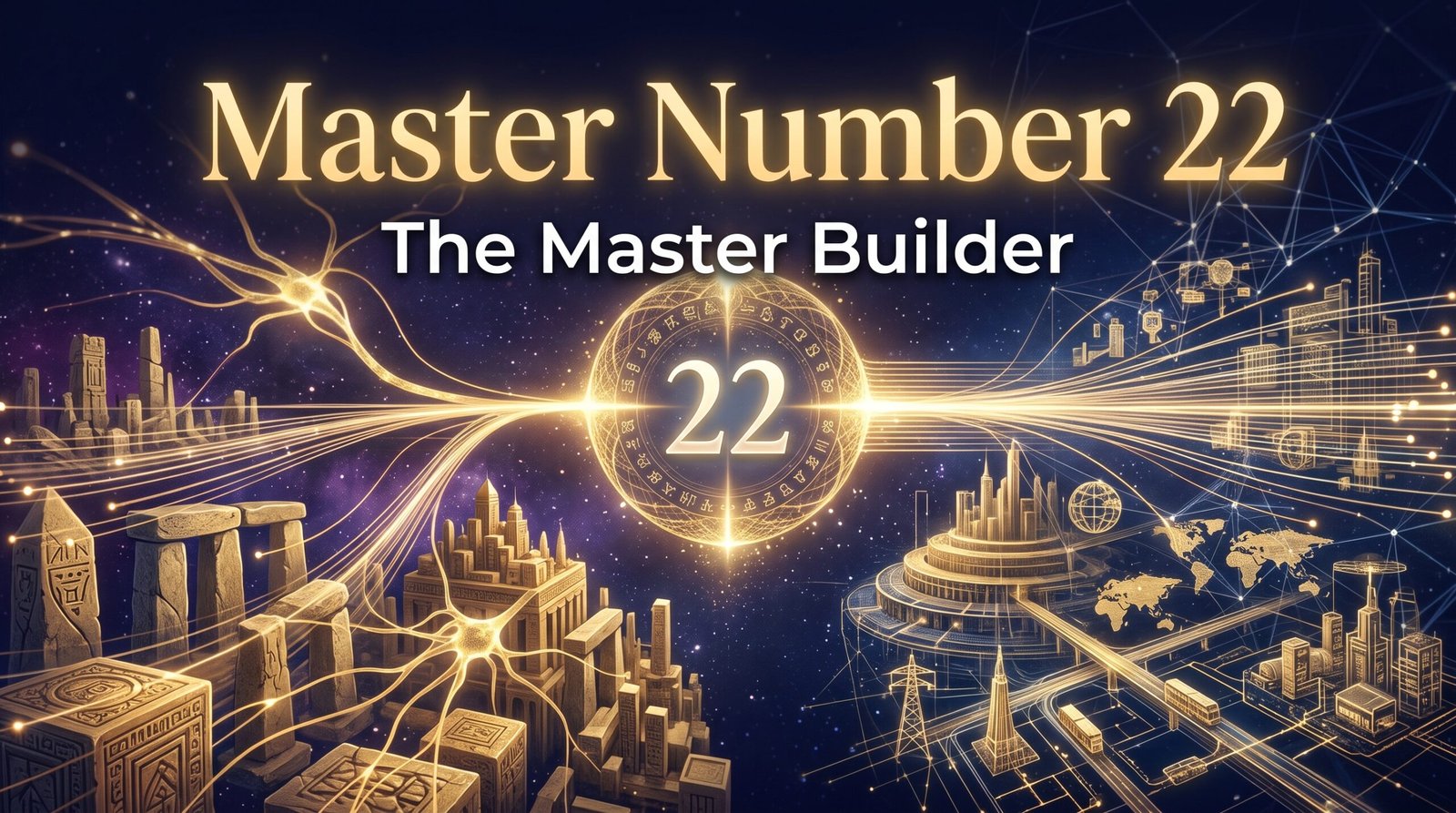
Master Number 22: The Master Builder
The Ultimate Deep Dive into Master Number 22
You are looking at a numerical blueprint that represents the highest level of operational execution in the human experience. While others see a simple number, you should view Master Number 22 as a rigorous architectural framework designed for building large-scale, tangible systems. It is not a lucky charm; it is a high-stakes demand for systemic scalability and disciplined management.
You carry the combined power of an 11’s vision and a 4’s practical grit. This means your life isn’t about small wins, but about constructing legacy infrastructure that stands the test of time. Think of it as the difference between building a backyard shed and engineering a global logistics hub. (I once tried to ‚wing it‘ on a project rollout without a system, and the resulting chaos taught me that structure is the only thing that saves your sanity.)
Key Insight: The 22 vibration acts as an advanced operating system, requiring you to master the art of delegation and precise self-regulation to avoid total burnout.
You will learn how to navigate the intense pressure of your own potential and how to apply this „Master Builder“ mindset to your career and personal partnerships. This guide breaks down the technical specs of your personality so you can move from dreaming to doing. You are here to turn massive ideas into concrete reality, one strategic brick at a time.
Before you begin your deep dive, you should confirm your specific placement on this path using the tool below.
->Check our Numbers Calculator here <-
The 22 Frequency: A Higher Vibration of Practicality
The 22 frequency functions as an intensified version of the Life Path 4, requiring you to operate with significantly higher stakes. While a standard 4 is built for stability and hard work, your 22 vibration demands that you take those foundational traits and scale them into something that impacts thousands, if not millions. I have seen many professionals struggle because they try to „work harder“ like a 4, when they should be „building systems“ like a 22.
This archetype relies on a specific internal mechanics: the visionary capacity of the 11 merged with the practical execution of the 4. You are not just a dreamer, and you are certainly not just a laborer. You are the person who sees a 50-story skyscraper in a vacant lot and possesses the technical knowledge to actually pour the concrete.
Core Operational Drivers
Your primary objective is the conversion of abstract, massive ideas into tangible, functioning reality. This is not about small-scale projects or temporary fixes; it is about creating legacy infrastructure. Whether you are developing a global logistics network or a multi-generational family business, your internal „operating system“ is hardwired for systemic scalability.
- Structural Integrity: You prioritize the „bones“ of a project over the aesthetic finish.
- Resource Orchestration: You view money and people as raw materials-the concrete and steel-required to manifest a plan.
- Empire Building: Your drive is directed toward systems that can survive and function without your constant manual intervention.
However, this intense drive for creation often carries a heavy weight. You might find yourself paralyzed by the sheer scale of your own potential, or worse, falling into a pattern of micromanagement. This pressure can lead to a specific type of rigidity, where the fear of a structural collapse makes you unwilling to start at all.
The weight of your own potential can become a structural weakness if you fail to manage the internal pressure that comes with the 22 frequency. When you realize the scale of what you are capable of constructing, the fear of a „miscalculation“ often leads to a specific type of paralysis. You might find yourself staring at a blank blueprint, terrified that your first move won’t support the weight of the final skyscraper.
Recognizing the Shadow Side of the Blueprint
In my years of consulting, I’ve seen high-performers crumble because they treated their personal energy like an infinite resource rather than a finite operational budget. For you, the „shadow side“ manifests as a rigid, almost dictatorial need for control. When stress levels spike, your natural drive for precision can morph into micromanagement, where you treat colleagues or partners as faulty components rather than collaborators.
Workaholism is another common failure point. You might feel that if you aren’t physically on-site laying every brick, the entire infrastructure will fail. This mindset isn’t just exhausting; it’s a systemic bottleneck that prevents your vision from ever reaching its full height.
Pro Tip: Use the „Rule of 10“ to combat paralysis: if a project feels too massive to start, break the next phase into ten micro-operations that can each be completed in under thirty minutes.
Strategies for Effective Scaling
To move from a stressed individual to a high-performance leader, you must master the art of functional delegation. This requires viewing delegation not as a loss of control, but as the installation of a more robust operating system. You are moving from being the engine to being the architect of the entire vehicle.
- Audit your „Control Points“: Identify which tasks actually require your specific signature and which can be managed via a Standard Operating Procedure (SOP).
- Embrace Iterative Building: Accept that the „bones“ of a project can be adjusted during the construction phase; you don’t need the final interior design finished before you pour the foundation.
- Schedule Downtime as Maintenance: Treat your rest periods as essential „system cooling“ to prevent a total hardware meltdown.
- Externalize the Vision: Get the massive ideas out of your head and into a project management tool to reduce the cognitive load of holding the entire plan at once.
Mastering these growth areas is the only way to ensure your empire doesn’t collapse under its own weight. How you handle this internal pressure today determines whether your future career and relationship dynamics will be built on solid rock or shifting sand.
Your career trajectory is not a ladder, but an engineering project designed for systemic impact. In the current US market, your success depends on moving away from manual labor and toward the high-level oversight of organizational structures. You aren’t here to just do a job; you are here to build the machine that does the job.
High-Impact Career Environments
To maximize your output, you need a theater of operations that matches your scale. You naturally thrive in sectors where complexity meets physical or digital reality, such as global logistics or international real estate. Firms like the Related Companies in New York represent the type of massive, multi-use development projects where your structural mindset can flourish.
If your interests lean toward technology, focus on large-scale tech infrastructure. Roles within AWS or Google Cloud initiatives allow you to architect digital foundations that support millions of users. Alternatively, urban planning or leadership roles in the NYC Department of City Planning provide the literal „concrete and steel“ environment where your vision becomes a public legacy.
The Financial Blueprint
You view money differently than most. For you, wealth is an operational resource-the raw materials required to fund your next phase of construction. Because your income growth is tied to project scope and systemic impact rather than hourly wages, your financial strategy must prioritize systemic scalability.
- Standardize Your Operations – Create Standard Operating Procedures (SOPs) for every repeatable task. I’ve found that even five minutes spent documenting a process saves fifty hours of future troubleshooting.
- Deploy a Delegation Matrix – Categorize your tasks by complexity and risk. Offload anything that doesn’t require your specific architectural oversight to a competent team.
- Establish Measurable KPIs – Use Key Performance Indicators to track progress. Without hard data, your drive to build can easily turn into aimless workaholism.
- Define Quarterly Legacy Objectives – Map out concrete, measurable steps that serve your long-term vision. This prevents you from getting lost in the „bones“ of a project and losing sight of the finished skyscraper.
While you are busy building these empires, remember that a master-planned city still needs a heart to function. The same relentless drive you bring to the boardroom often follows you home, creating a unique set of challenges when you try to switch from „Chief Executive“ to „Partner.“
For a deeper, personalized career blueprint, explore your targeted success report: https://numerologist.com/
Recent surveys of US couples show that 12-15 hours of „quality time“ per week is the sweet spot for relationship satisfaction, yet your drive to build a legacy often makes that number feel like an unattainable luxury. While you might view a romantic partner as a co-architect in your grand design, it is easy to forget that a home is not a job site. If you aren’t careful, your natural tendency to optimize everything can turn your living room into a satellite office where emotional intimacy is replaced by status reports.
The Competency Requirement
You need a partner who is exceptionally stable and competent. You aren’t looking for someone to „fix“; you need someone who understands that your obsession with building systems is a core part of your identity, not a hobby you’ll eventually outgrow. I’ve found in my own consulting work that high-achievers often fail in love when they pick partners who compete with their mission rather than anchoring it. Your ideal match is someone who provides a grounded reality while you are busy scaling the next skyscraper.
Pro tip: Treat your relationship as the foundation of your empire, not a department within it; if the foundation cracks, the whole structure eventually leans.
Avoiding the „Project Update“ Trap
Because you think in terms of operational execution, your dinner conversations can quickly default to „project update“ mode. You might find yourself analyzing a partner’s emotional vent as a problem to be solved with a Standard Operating Procedure. This is a mistake. Conflict resolution for you must move beyond a mere problem-solving exercise and into the realm of shared feeling, or you risk your partner feeling like just another line item on your balance sheet.
- Set Boardroom Boundaries: Establish specific „no-work“ zones in the house where business talk is strictly prohibited.
- Schedule Non-Agenda Dates: Force yourself into weekly activities that have no goal, no ROI, and no „next steps.“
- Practice Emotional Mirroring: Before offering a solution to a partner’s problem, summarize their feelings to ensure they feel heard, not just „managed.“
- Audit Your Quality Time: Track your 12-15 hour goal like a KPI to ensure your personal infrastructure isn’t being neglected.
Building a lasting personal bond requires the same systemic scalability you apply to your business, but with a softer touch. For a deeper, personalized relationship compatibility analysis, explore your targeted success report: https://numerologist.com/
The challenge lies in whether you can apply your massive executive power to the quiet, often messy work of human connection. Some of the world’s most famous builders have managed this balance, while others let their personal lives crumble beneath the weight of their monuments.
Architects of Reality: Famous Master Builders in Action
Success for a 22 is never an accident of fate, but the result of applying a rigorous architectural framework to a massive vision. While many people have big ideas, very few possess the structural stamina to turn a single concept into a global infrastructure. By looking at those who have already scaled the heights of the US and international markets, you can see how your own blueprint translates into tangible, high-performance results.
Sir Richard Branson: The Global Infrastructure Strategy
Sir Richard Branson serves as a premier example of how you can use systemic scaling to dominate multiple industries simultaneously. Rather than sticking to one niche, he used the Virgin Group to build a sprawling empire that spans airlines, telecommunications, and space travel. His approach mirrors your inherent need to create frameworks that function independently of your daily labor.
With an estimated net worth of $2.9 billion as of 2023, Branson’s career proves that wealth is merely the „concrete and steel“ required for further construction. He doesn’t just start businesses; he builds operational ecosystems that allow for rapid expansion. For you, the lesson is clear: your value lies in designing the machine, not in being the most hardworking cog within it.
Shonda Rhimes: The Creative Empire Architect
Shonda Rhimes redefined the entertainment industry by treating storytelling as a massive, structured creative empire. Through her production company, Shondaland, she moved beyond being a writer to becoming a systemic force. She didn’t just produce hit shows like Grey’s Anatomy or Scandal; she built a factory of high-performance creative execution that delivers consistent results.
Her 2021 deal with Netflix, valued at over $300 million, highlights the financial power of the Master Builder when they master delegation. Rhimes succeeded because she established a scalable operational framework that maintains quality across dozens of projects. She demonstrates that even in „soft“ industries like art, the 22 frequency demands a rigid, professional structure to achieve a lasting legacy.
Strategic Takeaways for Your Empire
- Diversify through systems: Like Branson, use your core operational model to expand into related sectors without starting from zero.
- Value institutional knowledge: Build a „production line“ for your ideas, ensuring your standards are met even when you aren’t in the room.
- Scale through partnership: Secure high-value contracts by proving your infrastructure can handle more volume than any individual competitor.
To see how your specific numerical blueprint aligns with these high-performance strategies, you can access a personalized analysis of your trajectory here: https://numerologist.com/
Your Operational Roadmap to a Lasting Legacy
Your Master Number 22 is an architectural blueprint for high-performance execution, not a guarantee of magical success. You possess the rare ability to turn abstract visions into physical infrastructure, but this power requires rigorous self-management to avoid structural collapse. You must treat your life like a large-scale engineering project where every resource is accounted for and every process is scalable.
Key Execution Principles
- Systems over sweat: You cannot build a global empire through raw personal labor alone. Success depends on your ability to design standard operating procedures (SOPs) that allow others to execute your vision.
- The 4/22 balance: You must ground your massive „22“ ambitions in the practical, disciplined habits of the „4“ foundation. Without a daily schedule and clear milestones, your big ideas remain expensive daydreams.
- Strategic delegation: Your primary job is the architect, not the bricklayer. You create the highest value when you focus on systemic scalability and hire competent specialists to handle the micro-operations.
- Emotional infrastructure: Your relationships require the same intentional design as your business. You must schedule non-negotiable time for your partner to prevent your personal life from becoming a neglected department.
Immediate Next Steps
Open your digital calendar today and audit your next forty-eight hours. Identify three repetitive tasks you currently perform that can be documented into a checklist and handed off to a team member or a software tool. This simple act of creating a repeatable system is the first step in scaling your influence from a single person to a permanent institution.
Building a legacy requires you to trade the comfort of total control for the power of a well-oiled machine.